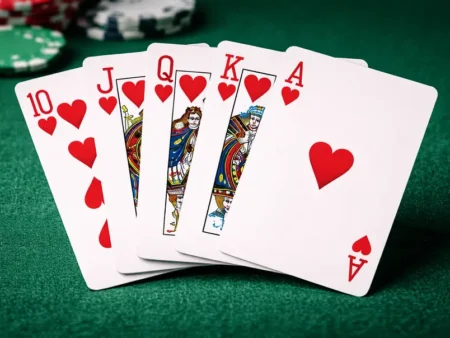
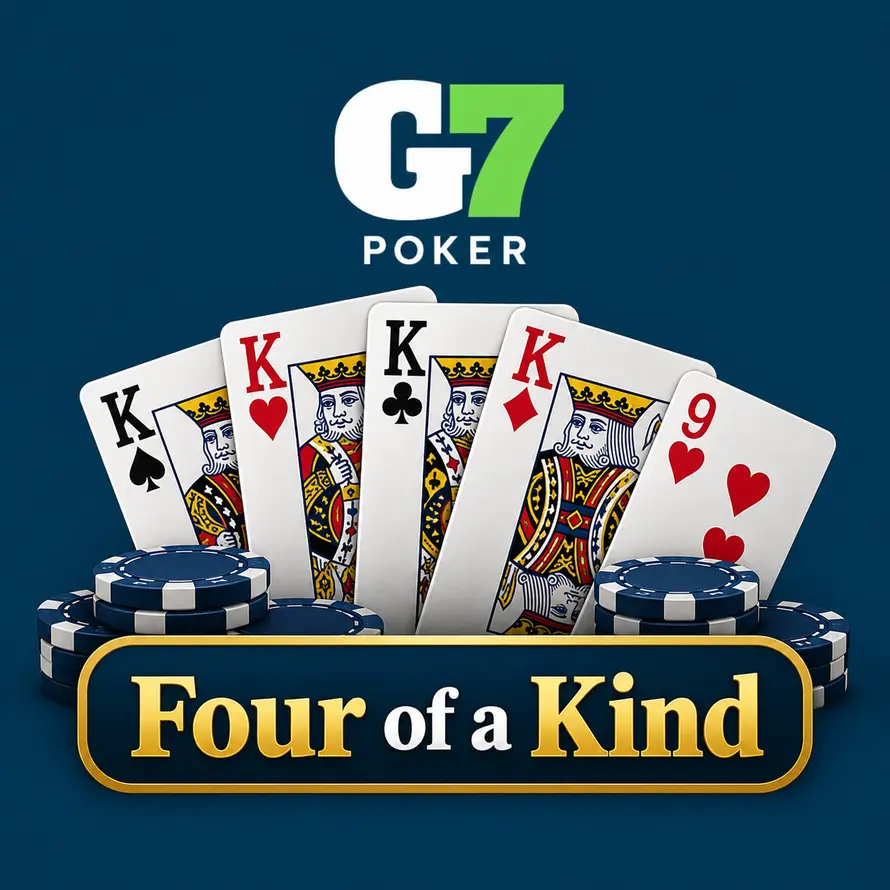
Four of a kind beats every hand in poker except a straight flush or a royal flush. If you hold four cards of the same rank, you have one of the rarest and most powerful hands in the game. A royal flush is technically the highest straight flush (A-K-Q-J-10 of one suit), so both belong to the same category, but naming them separately avoids any confusion. Below is everything you need to know: rankings, odds, strategy, and the mistakes most players make with quads.
What Is Four of a Kind in Poker?
Four of a kind is a poker hand made up of four cards of identical rank plus one unrelated side card called the kicker. For example, holding four kings and a nine (K♠ K♥ K♦ K♣ 9♠) gives you four of a kind, kings. The hand is also called “quads” at the table.
The rank of the four matching cards determines the hand’s strength. Four aces is the strongest possible four of a kind; four twos is the weakest. If two players hold the same quads (possible when all four appear on the board in Hold’em), the kicker decides the winner.
Where Does Four of a Kind Rank?
In the standard poker hand rankings used in Texas Hold’em, Omaha, and most variants, four of a kind sits third overall. Some sources list it second because a royal flush is technically a type of straight flush, not a separate category. Both descriptions point to the same reality: the only hands that beat quads are straight flushes.
| Rank | Hand | Example | 5-Card Probability |
|---|---|---|---|
| 1 | Royal Flush | A♠ K♠ Q♠ J♠ 10♠ | 0.000154% |
| 2 | Straight Flush | 8♦ 7♦ 6♦ 5♦ 4♦ | 0.00139% |
| 3 | Four of a Kind | K♠ K♥ K♦ K♣ 9♠ | 0.0240% |
| 4 | Full House | A♠ A♥ A♦ 8♣ 8♠ | 0.1441% |
| 5 | Flush | A♠ J♠ 8♠ 5♠ 3♠ | 0.1965% |
| 6 | Straight | 9♠ 8♦ 7♣ 6♥ 5♠ | 0.3925% |
| 7 | Three of a Kind | 7♠ 7♥ 7♦ K♣ 3♠ | 2.1128% |
| 8 | Two Pair | J♠ J♦ 4♣ 4♠ 9♥ | 4.7539% |
| 9 | One Pair | 10♠ 10♦ A♣ 7♥ 2♠ | 42.2569% |
| 10 | High Card | A♠ J♦ 8♣ 5♥ 2♠ | 50.1177% |
What Beats Four of a Kind in Poker?
Only a straight flush or royal flush beats four of a kind. A straight flush is five consecutive cards of the same suit (for example, 5♥ 6♥ 7♥ 8♥ 9♥). A royal flush is just the highest possible straight flush, so it beats quads as well. Does four of a kind beat a full house? Yes, always. Even the best full house (aces full of kings) loses to the weakest quads (quad twos). The math is simple: 624 possible four-of-a-kind hands versus 3,744 possible full houses. Rarer hand wins.
Four of a Kind Odds and Probabilities
In a random five-card deal, quads appear with a probability of 0.024%, or roughly 4,164-to-1 against. That figure comes from 624 possible four-of-a-kind combinations out of 2,598,960 total five-card hands. The combinatorics are straightforward: 13 ranks times 48 possible kickers equals 624.
In Texas Hold’em, where you work with seven cards by the river, the odds improve to about 0.168% (594-to-1). If you start with a pocket pair, flopping quads specifically happens roughly once every 407 deals. In Pot-Limit Omaha, four hole cards push the probability to approximately 0.20% (499-to-1), though you must use exactly two hole cards under Omaha rules.
How Four of a Kind Forms in Texas Hold’em
1. Pocket Pair Hits Two on the Board
The most profitable scenario. You start with a pocket pair, and two more matching cards appear on the board. No opponent can see any of your four matching cards, making this the hardest version of quads to detect and the easiest to extract value from.
2. One Hole Card Matches Three on the Board
The board shows three cards of the same rank, and you hold the fourth. More transparent, since every observant opponent knows someone could have the case card. Moderate your bet sizing to keep full houses calling.
3. All Four on the Board
When the board itself shows all four cards of a rank, every player shares the same quads. The hand becomes a kicker contest decided entirely by the highest remaining hole card.
How to Play Four of a Kind
The primary challenge with quads is getting paid. Slow-play (checking or calling instead of raising) works best when you hold a pocket pair that matched the board on a dry texture; your hand is completely disguised, so letting opponents bet into you is often more profitable than raising immediately.
On wet, connected boards where flush or straight draws are possible, bet or raise. Opponents drawing to those hands will call now but fold if they miss on a later street, so building the pot early maximizes value. When all four matching cards appear on the board, the strategy shifts to a kicker contest: if you hold an ace, you likely have the nuts; if your kicker is weak, proceed cautiously.
What Most Players Get Wrong About Four of a Kind
1. Assuming Quads Cannot Lose
Four of a kind loses to a straight flush. If the board is heavily coordinated (three suited connected cards alongside a pair), a straight flush is theoretically possible. Always check the board texture before committing your entire stack.
2. Overplaying When the Board Shows Trips
When three of a rank sit on the board and you hold the fourth, your quads are visible to every alert opponent. Blasting a pot-sized bet folds out everything except a full house. Keep bet sizes moderate so strong-but-second-best hands have a reason to call.
3. Ignoring the Kicker in Board-Quad Spots
When the board itself shows four of a kind, your highest hole card is the only thing that matters. Calling large bets with a low kicker is a leak; treat board-quad situations like a high-card contest, because that is exactly what they are.
4. Slow-Playing on Draw-Heavy Boards
Reflexively checking quads regardless of board texture is a costly habit. On boards with flush or straight draws, opponents will either catch free cards (potentially completing a straight flush) or miss and fold on the river. Betting now builds the pot while they still have equity worth paying for.
Four of a Kind in Other Variants and Bad Beat Jackpots
The hand ranking of quads is identical across Hold’em, Omaha, Seven-Card Stud, and most standard formats. In Short Deck Hold’em (where cards below 6 are removed), quads appear more often because the deck is only 36 cards, but the hand still outranks a full house.
In many live cardrooms and online rooms, four of a kind plays a central role in bad beat jackpots. The typical requirement is that a player must lose with quad eights or better. If you hold qualifying quads, make sure the hand goes to showdown; folding to avoid a small loss could mean forfeiting a jackpot worth thousands of dollars.
Key Takeaways
- Four of a kind (quads) is four cards of the same rank plus a kicker, ranking third overall. Only a straight flush (including a royal flush) beats it.
- Quads always beat a full house: 624 possible four-of-a-kind hands versus 3,744 full houses. Rarer hand wins.
- In Texas Hold’em, you will make quads roughly once every 595 hands dealt to the river. Flopping quads with a pocket pair happens about once in 407 deals.
- The biggest strategic error is playing quads the same way regardless of board texture. Slow-play on dry boards; bet or raise on wet, connected boards.
- When all four matching cards appear on the board, the hand reduces to a kicker contest. Your highest hole card is the only thing that matters.