
You’re on the turn with a flush draw. Villain bets, you run the pot-odds math, and the price is bad. If you stop there, it’s a fold. But that calculation only sees the chips already in the middle. It says nothing about the chips you may win on the river when the heart gets there.
That’s the job of implied odds: putting a realistic value on the money that can go in later. In practice, this is where a lot of marginal draw calls are won or lost.
What Are Implied Odds in Poker?
Implied odds compare the cost of calling now with the total amount you expect to win if your draw comes in: the current pot plus future bets. That extra money can make a call worthwhile even when the immediate pot odds are short.
The word that matters is implied. None of those future chips are locked up. You still need to make the best hand, your opponent needs chips behind, and they need to be willing to put more money in after the draw completes.
Older strategy books often call the same idea implied pot odds. The term is different; the calculation is not.
Pot Odds vs Implied Odds
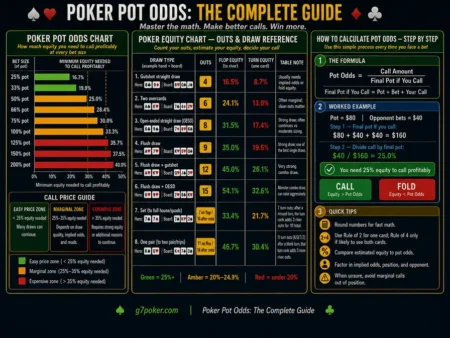
Pot odds are the price you’re getting right now, based only on money already committed. Implied odds look one street ahead and ask what you can reasonably win later. Pot odds are fixed by the current pot and bet size. Implied odds are an estimate, and stack depth, position and opponent tendencies change that estimate. If the base calculation is unfamiliar, our guide to poker pot odds walks through it step by step.
| Factor | Pot Odds | Implied Odds |
|---|---|---|
| Money counted | Chips already in the pot | Current pot plus expected future winnings |
| Precision | Exact | Estimate |
| Depends on stack depth | No | Heavily |
| Depends on your opponent | No | Yes |
| Question it answers | Is this call profitable right now? | How much more must I win to make this call profitable? |
I use them in that order: pot odds first, implied odds second. If the current price already makes the call, there is no need to invent future action. When the price is short, then you ask how much extra you need to win and whether that number is realistic.
How to Calculate Implied Odds
You cannot know the exact amount an opponent will pay on the next street. What you can calculate is the minimum extra amount you need to win for the call to break even.
Formula: Extra winnings needed = (Call ÷ Equity) – (Pot + Call)
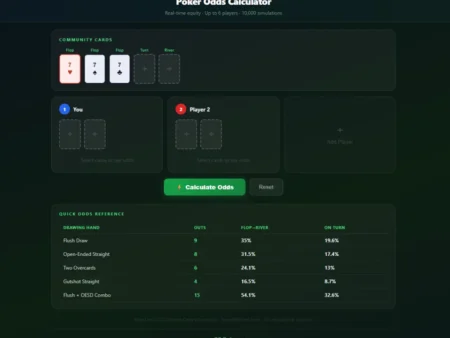
Here, pot includes your opponent’s bet, and equity is your chance of improving on the next card written as a decimal. For a one-card draw, divide your outs by the unseen cards: 47 on the flop or 46 on the turn. You can also use our odds of poker hands calculator for the exact percentage.
Example: Nut Flush Draw on the Turn
You’re playing $1/$2 with $400 stacks and hold K♥Q♥ on A♥ 7♥ 2♣ 4♠. The pot is $60. Your opponent bets $40, so the decision is whether to call $40 into a pot that is now $100.
- Pot odds needed: $40 ÷ $140 = 28.6%
- Chance to hit the flush: 9 clean outs ÷ 46 unseen cards = 19.6%
- Extra winnings needed: ($40 ÷ 0.196) – $140 = $64
The immediate price says fold. You have 19.6% equity but need 28.6%. The implied-odds question is whether you can make up the gap by winning at least another $64 on the river. With more than $300 left in your opponent’s stack, that amount is available to win. If you expect an ace to pay a river bet of around $64 often enough, the call can make money.
Now change only one thing: your opponent has $30 left. You still need $64 in future winnings, but there is only $30 available. That closes the case. Same cards, same draw, different stack size – fold.
Implied Odds Cheat Sheet by Draw
For a quick benchmark, take a half-pot turn bet: $50 to call when the pot is $150 after the bet. The direct pot-odds threshold is 25%. The table shows how much additional money each common draw would need to win later.
| Draw | Outs | Equity (One Card) | Extra Winnings Needed |
|---|---|---|---|
| Gutshot straight draw | 4 | 8.7% | $375 |
| Open-ended straight draw | 8 | 17.4% | $88 |
| Flush draw | 9 | 19.6% | $56 |
| Flush draw + open-ender | 15 | 32.6% | $0 (pot odds are enough) |
The gap between a gutshot and a flush draw is bigger than it looks at the table. A four-out gutshot needs another $375 after calling, which is two and a half times the current pot. That is a demanding payoff to count on. A nine-out flush draw needs $56, while the 15-out combo draw already has enough equity on the immediate price.
What Makes Implied Odds Good or Bad?
The cards alone do not tell you whether the implied odds are good. I look at the money behind, how obvious the draw will be when it lands, whether I’m drawing to the nuts, position and the type of opponent paying the bet.
- Stack depth: Start with the effective stack, not the stack you wish you could win. You can only win what the shorter stack still has behind.
- Disguise: Hidden improvements get paid more often. Sets and straights on dry boards are harder to read than a flush completing when the third suited card hits the board.
- Nut potential: The cleaner the draw, the safer it is to count future money. Drawing to the best possible hand reduces the chance that you improve and still lose a large pot.
- Position: Acting last gives you more control over the size of the pot after you hit and lets you get away more cheaply when you miss.
- Opponent type: Future money only counts if the opponent is willing to put it in. Loose callers create more implied-odds value than players who shut down as soon as the obvious draw completes.
Reverse Implied Odds
Reverse implied odds are the extra money you can lose after hitting your draw and still ending up with the second-best hand. Say you call with 6♥5♥ on K♥ J♥ 8♣ and another heart comes. You make a flush, but it is still a small one. If your opponent started with two higher hearts, you can hit your draw and still lose a big pot. These are the hands that cost you because your flush looks too strong to get away from easily. That is why small draws carry more reverse implied odds than draws to the nuts.
Key Takeaways
- Implied odds count expected future winnings as part of the decision to call.
- Implied pot odds is another name for the same concept.
- Use (Call ÷ Equity) – (Pot + Call) to calculate the extra amount you need to win, then compare that number with the money realistically available on later streets.
- Deep effective stacks, disguised draws, nut potential and opponents who pay off make future winnings easier to justify.
- Reverse implied odds matter when improving can still leave you with the second-best hand.