The first time pot odds clicked for me was at a $1/$2 live game. I was on the flop with a flush draw, staring at a bet I had no idea whether to call. I folded. The turn brought my flush card. The river brought it again. I had folded the best hand twice in a row because I had no framework for deciding. That was the last time I played without understanding pot odds.
Pot odds are the single most practical math skill in poker. They are not complicated. You do not need to be good at math. You need to understand one ratio, practice it a few times, and you will never make another guess when facing a bet on a drawing hand.
This guide will walk you through exactly how pot odds work, how to calculate them fast at the table, how to combine them with your outs, where they fall short (and what to use instead), and how to apply all of this in real hands.
What You Will Learn
- What pot odds actually mean in plain language
- The simple formula and how to calculate in under five seconds
- The pot odds cheat sheet (memorize these five numbers)
- How to count outs and combine them with pot odds
- The Rule of 2 and 4 for quick equity estimates
- Implied odds: when pot odds alone are not enough
- Reverse implied odds: the hidden cost of some draws
- Pot odds on the river: a different way of thinking
- Common mistakes and how to fix them
- Practice hands with full worked examples
What Are Pot Odds?
Pot odds describe the relationship between the size of the bet you are facing and the size of the pot. They tell you the minimum percentage of the time you need to win this hand for calling to make financial sense over the long run.
Here is the core idea in one sentence: if the price you are paying to see the next card is cheap relative to the pot you stand to win, calling is profitable even if you lose more often than you win.
Consider this analogy. Imagine someone offers you a bet: you put in $1, they put in $10, and you flip a coin. You win 50% of the time, but you are getting paid $10 for every $1 you risk. That is a massively profitable bet even though you only win half the time. Pot odds work the same way, scaled to the chips in front of you.
The reason this matters is that most players, especially those still learning how to play poker, assume they should only call when they expect to win more than half the time. That thinking loses money. Because there is already money in the pot, you are always risking less than you stand to win. A call can be correct even when you expect to lose the hand twice as often as you win.
Pot Odds vs Equity
Pot odds and equity are closely related, but they are not the same thing. Pot odds tell you the price you are getting on a call. Equity tells you how often you expect to win the pot if the hand continues to showdown. The basic decision is simple:
- If your equity is greater than the equity required by your pot odds, calling is profitable.
- If your equity is lower than the equity required by your pot odds, folding is usually the correct decision. For example, if a half-pot bet requires 25% equity to call and your flush draw has approximately 36% equity, the call is profitable because your chance of winning exceeds the price you are being offered.
The Pot Odds Formula
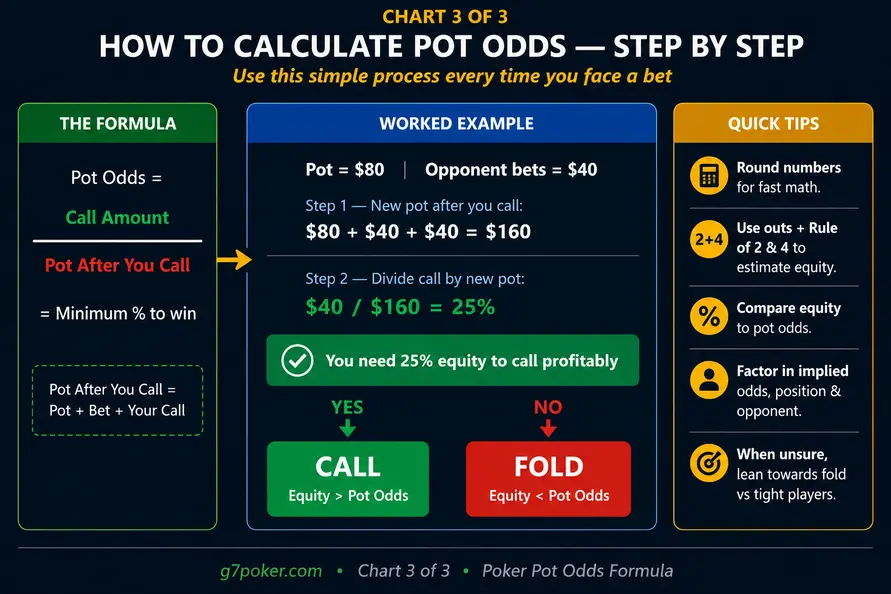
Let’s work through a concrete example.
The pot is $80. Your opponent bets $40. You are thinking about calling.
Step 1: Figure out the pot after you call. The pot is $80, your opponent put in $40, and if you call you put in $40. That makes the total pot $160.
Step 2: Divide your call by the total pot. $40 divided by $160 = 0.25, which is 25%.
Step 3: Interpret the result. You need to win this pot at least 25% of the time for calling to be profitable over many repetitions of this spot.
That is the whole calculation. Nothing more.
A Simpler Way to Think About It
Some players find it easier to think in ratios before converting to a percentage. Using the same example:
You are risking $40 to win $120 (the $80 that was already there plus your opponent’s $40). That is 3 to 1 odds in your favor. To find your break-even percentage, divide 1 by (3 + 1) = 25%.
Pot Odds Chart & Reference Table
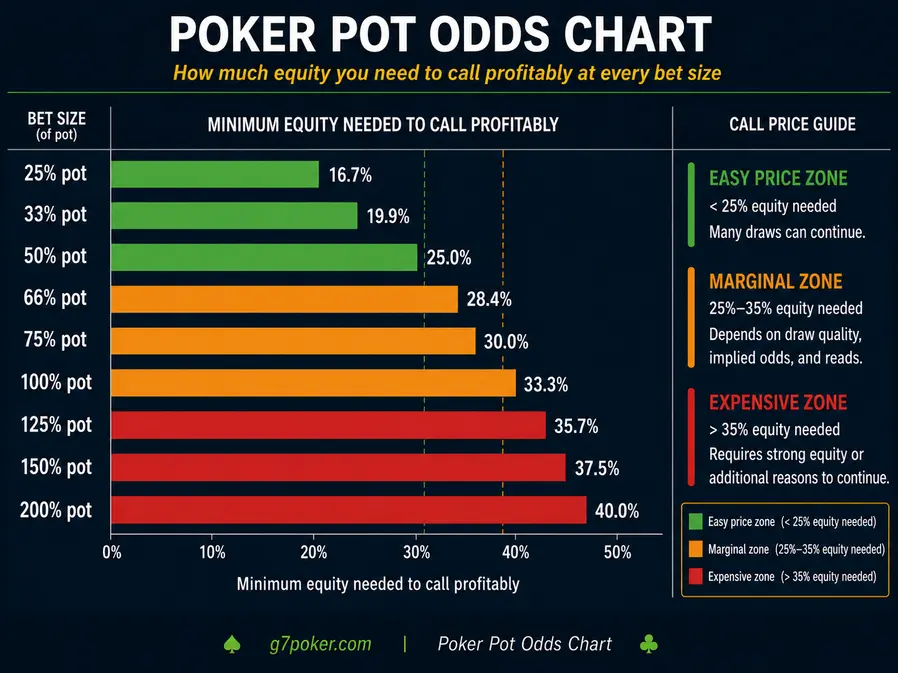
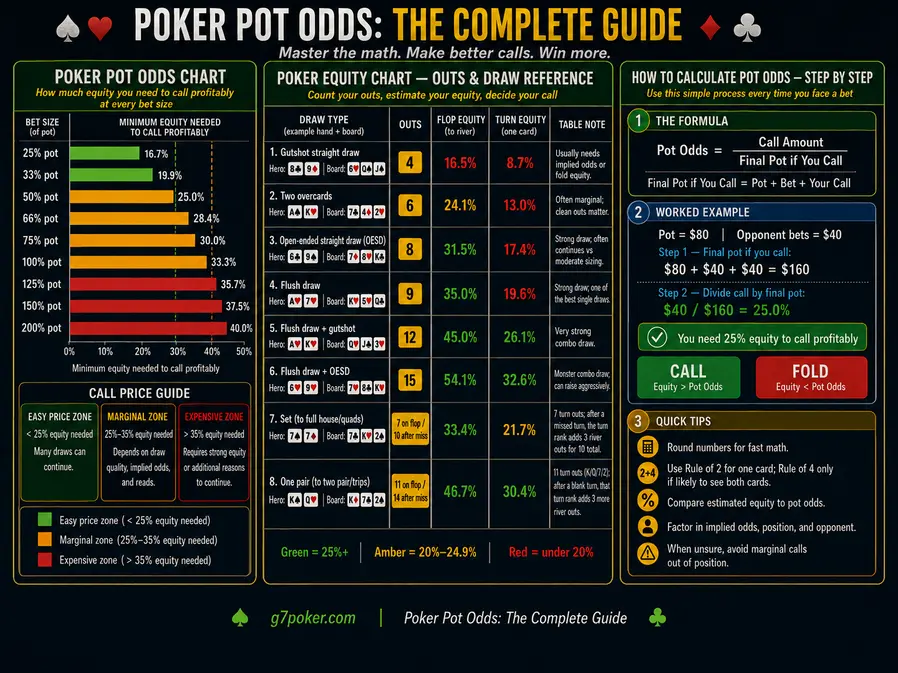
Below is a reference for every standard bet size you will encounter. The right column tells you the minimum equity you need to call profitably. Memorize the five most common ones (33%, 50%, 66%, 75%, 100%) and you will be covered in the vast majority of real hands.
The five to know cold: A third-pot bet requires 20% equity to call. A half-pot bet requires 25%. A two-thirds-pot bet requires about 29%. A pot-sized bet requires 33%. An overbet of 150% requires roughly 43%.
Counting Outs: How to Know Your Equity
Pot odds give you the price. To use them, you need to know the other side of the equation: how often you are going to win. That comes from counting outs.
An out is any card remaining in the deck that will complete your hand and make it the likely winner. The word ‘likely’ matters here. Count outs only for cards that will actually give you the best hand, not cards that complete a draw but might still lose to a better hand.
How to Count Outs: Common Draws
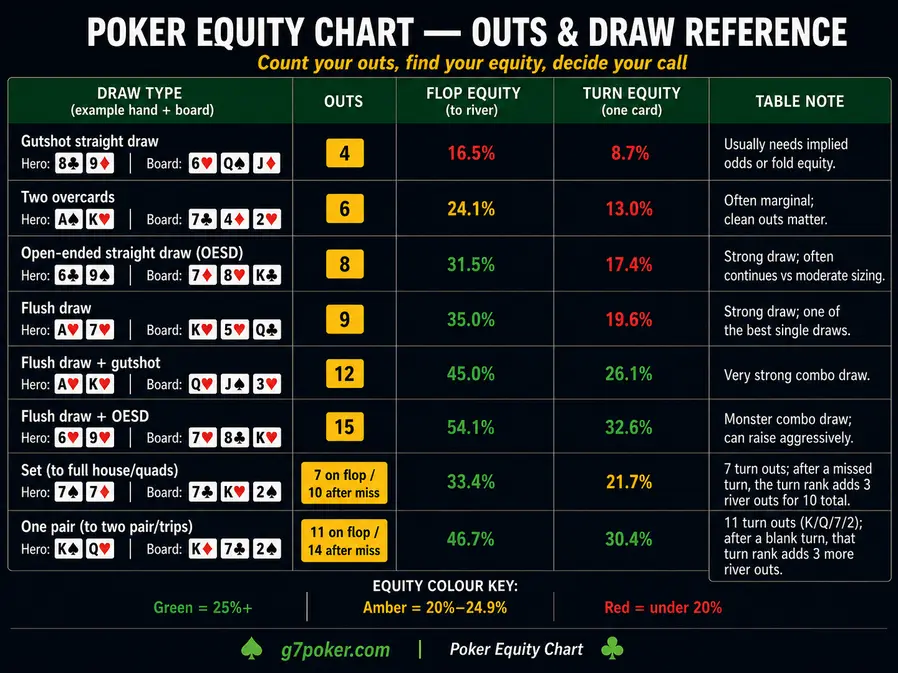
Here are the most frequent drawing situations and their out counts:
A note on the flush plus open-ended straight draw: this is one of the most powerful draws in poker. With 15 outs on the flop, you are actually a slight favorite to improve by the river. That changes how you think about the hand significantly.
The Rule of 2 and 4: Fast Equity at the Table
Counting outs gets you the number of cards that help you. The Rule of 2 and 4 converts that number into an approximate equity percentage, fast, without needing a calculator or equity software.
Flush draw example (9 outs):
On the flop, you have 9 outs. Multiply by 4 = 36% estimated equity to hit by the river.
On the turn, same draw, one card left. Multiply by 2 = 18% estimated equity to hit the flush.
Open-ended straight draw example (8 outs):
Flop: 8 x 4 = 32% equity. Turn: 8 x 2 = 16% equity.
This rule is not perfectly precise. The actual math gives you slightly different numbers, but the difference is almost never meaningful enough to change your decision. The Rule of 2 and 4 is accurate enough for table use and far better than guessing. For a deeper look at how card tracking and outs connect, read our guide on counting cards in poker.
Putting Pot Odds and Outs Together: Full Example
You are on the flop in a $1/$2 cash game. The pot is $30. You hold the king and queen of hearts. The board shows jack of hearts, seven of hearts, two of spades. You have a flush draw.
Your opponent bets $20 into the $30 pot. Should you call?
Step 1: Calculate pot odds.
Pot after you call = $30 + $20 + $20 = $70. Your call = $20. Pot odds = $20 / $70 = 28.6%. You need about 29% equity to call.
Step 2: Calculate your equity.
You have 9 outs (the flush draw). On the flop with two cards to come: 9 x 4 = 36%.
Step 3: Compare.
Your equity (36%) is greater than the equity you need to call (29%). Calling is profitable. You have a clear call.
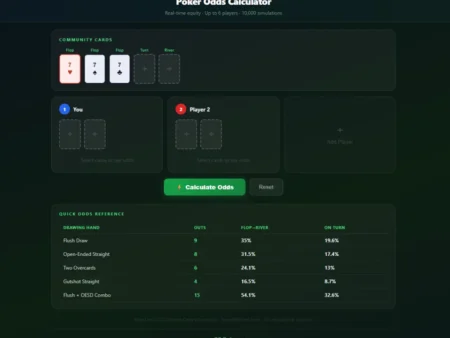
Notice you are going to miss this draw about 64% of the time by the river. You are still calling because the price is right. This is what pot odds do for you: they replace gut feelings with a consistent framework. You can double-check your equity estimates any time using our free poker odds calculator.
Implied Odds: When Pot Odds Alone Are Not Enough
Pot odds only tell you the immediate price of the call. They do not account for the money you can win on future streets if you hit your hand. That is where implied odds come in.
Implied odds are the pot odds you are getting, plus an estimate of what extra money you expect to win after completing your draw. They matter most in two situations:
- When you do not have the direct pot odds to call, but you expect to win a large amount on later streets if you hit
- When playing with deep stacks, where the money behind can dwarf the current pot size
A Practical Implied Odds Situation
You are in a $1/$2 live game with $300 effective stacks. The pot is $20. An early position player bets $15. You are in the big blind with five and six of spades, a speculative hand with potential for a strong straight or flush draw if the flop hits.
Direct pot odds: $15 / ($20 + $15 + $15) = $15 / $50 = 30%. You need 30% equity to continue. A hand like 5♠6♠ often has roughly 35-40% raw equity against many tight opening ranges, but much of that equity comes from making strong hands on later streets. Out of position, it can be difficult to realize all of that equity, which is why implied odds become an important part of the decision.
But if you hit a strong draw or a disguised two pair on the flop, you can often stack your opponent on later streets. With $285 more behind after the call, you have substantial implied odds. If you expect to win $200 on average when you hit and your opponent continues with their strong hands, calling becomes profitable.
The key question with implied odds: How likely is your opponent to pay you off when you complete your draw? Against players who continuation bet frequently but fold to raises, your implied odds are low because they will not put more money in after you hit. Against players who are sticky or who tend to call down with top pair, your implied odds are high.
Reverse Implied Odds: The Hidden Danger
Reverse implied odds are the flip side of implied odds. They describe situations where, even if you hit your draw, you may still lose money because your opponent will have a better hand or will not pay you off.
The classic example is a gutshot straight draw with a low kicker, or hitting the low end of a straight. If you have 4-5 and the board is 6-7-K, you are drawing to an eight for a straight. But any opponent holding 8-9 already has a higher straight, and an eight completing your hand could easily be completing theirs first.
When Reverse Implied Odds Are Worst
- Drawing to the low end of a straight (the ‘idiot end’)
- Flush draws where your flush cards are low and your opponent likely has a higher flush draw
- Two-pair draws when the board has obvious straight or flush possibilities
- Hands where improving to a good hand still loses to a better hand
When reverse implied odds are significant, you need more direct pot odds than you would otherwise. Some draws that look attractive based on outs alone are actually losing calls once you factor in how often you hit and still lose.
Pot Odds on the River: It Works Differently
Everything we have covered so far applies mainly to the flop and turn, where you still have cards to come and are using outs and equity. The river is different.
On the river, all the cards are out. You either have the best hand or you do not. There are no more draws to complete. So how do pot odds apply?
On the river, pot odds tell you the minimum win rate you need from a call. If the pot is $100 and your opponent bets $50, you are getting 3:1 on a call, meaning you need to win 25% of the time to break even. The question becomes: given your hand strength and the betting action, how often is your hand the winner?
Pot odds and bluff frequency: Understanding pot odds on the river also helps you think about your opponent’s bluff frequency. If someone bets half pot, they are offering you 25% pot odds. Against this sizing, a balanced opponent will generally have about one bluff for every two value bets. If you believe your opponent bluffs more often than that, calling becomes more attractive. If they rarely bluff, folding becomes the better decision even when you have a reasonable bluff-catcher.
Common Pot Odds Mistakes and How to Fix Them
Mistake 1: Counting Dirty Outs
A dirty out is a card that appears to help you but actually gives your opponent a better hand. For example, if you have a flush draw but one of your flush cards would complete a full house for your opponent, that card is a dirty out and should not be counted. Be conservative with your out count.
Mistake 2: Calling With Wrong Outs on the Flop
When you have two cards to come, you can use the x4 multiplier, but only if you are treating it as a single decision (a flop call followed by a turn call). If facing a large bet that puts you close to all-in, use x2 for just the next card. The x4 shortcut assumes you will see both the turn and river, which is only accurate if you expect to be able to call on the turn as well.
Mistake 3: Ignoring Position
Pot odds give you a mathematical floor for calling. They do not tell you about position, which matters enormously. Out of position, you should often need better pot odds than the math strictly requires, because being first to act on future streets costs you money over time. In position, you can be slightly more liberal with calls because your positional advantage partially compensates.
Mistake 4: Forgetting Future Streets
On the flop, calling based purely on pot odds without considering what happens on the turn and river is a mistake. If you hit your draw on the turn, will you be able to continue? If you miss, will you be able to make a profitable fold? Pot odds are one input, not the complete answer.
Mistake 5: Overvaluing Implied Odds
Players frequently call when they are getting poor direct pot odds by telling themselves their implied odds make up for it. This is correct in specific spots, but it requires your opponent to actually put more money in when you hit. If they fold frequently to pressure on later streets, your implied odds are much lower than you think.
Three Practice Hands: Apply What You Know
Hand 1: Cash Game Flush Draw
Game: $1/$2 No-Limit Hold’em. Effective stacks: $200. You raise to $7 from the button with Ace of diamonds, Jack of diamonds. The big blind calls.
Flop: King of diamonds, nine of diamonds, four of clubs. Pot: $15. Big blind bets $10.
Question: Call or fold?
Pot odds: $10 / ($15 + $10 + $10) = $10 / $35 = 28.6%.
Outs: 9 clean flush outs. Some aces may also be good against certain ranges, but they are not guaranteed winners. Using the Rule of 4, 9 × 4 ≈ 36% equity. Since you only need 28.6% equity to call, this is still an easy call.
Answer: Easy call. Your equity of 44% comfortably beats the 28.6% you need.
Hand 2: Turn Decision With One Card Left
Game: $2/$5 No-Limit Hold’em. Pot on the turn: $90. Board: Queen of spades, seven of hearts, two of clubs, ten of diamonds. You hold Jack of hearts, nine of spades. Open-ended straight draw. Your opponent bets $70.
Question: Call or fold?
Pot odds: $70 / ($90 + $70 + $70) = $70 / $230 = 30.4%.
Outs: 8 (four eights and four kings complete your straight). One card to come. 8 x 2 = 16% equity.
Answer: Fold based on direct pot odds. 16% is well below the 30.4% you need. Unless implied odds are very strong, this is not a profitable call.
Hand 3: River Call Against a Potential Bluff
Game: $1/$2 No-Limit Hold’em. Pot: $120. River board: Ace of hearts, King of clubs, seven of diamonds, four of spades, two of hearts. You hold King of hearts, Queen of clubs, giving you second pair. Your opponent, who has been aggressive all hand, bets $60.
Question: Call or fold?
Pot odds: $60 / ($120 + $60 + $60) = $60 / $240 = 25%.
No outs to count. This is a river decision. You need to win 25% of the time for the call to be profitable. Given your read that this opponent bluffs frequently, and that second pair has some showdown value, you estimate winning around 35% of the time. Call.
Pot Odds in Tournaments vs. Cash Games
Pot odds math is the same in both formats, but the implications are different in one key way: tournament chips are not worth their face value in the same way cash game chips are.
In cash games, a chip always equals its dollar value. In tournaments, the chip you have is often worth more than the chip you could gain because survival has value. This effect becomes most important near bubbles, major pay jumps, and final tables, where ICM considerations can make marginal chip-EV calls unprofitable even when they would be acceptable in a cash game.
This concept, called ICM (Independent Chip Model), is a deep topic on its own. The takeaway for pot odds: in cash games, math alone often dictates your decision. In tournaments, you sometimes need a mathematical edge to justify a call rather than simply breaking even.
Applying Pot Odds Live vs. Online
Online, the software tracks the pot size for you. You always know exactly what you are being offered. Calculating pot odds online is fast and accurate.
Live, you need to track the pot yourself. This takes practice. A few habits that help:
- Count the pot before you look at your cards on each street. It only takes a second and keeps you oriented.
- When facing a bet, do the division in your head using rounded numbers. Precision to two decimal places does not matter.
- Memorize the five key pot odds percentages (20%, 25%, 29%, 33%, 43%) so you can mentally match the bet size to the threshold quickly.
- Do not let time pressure rush you into a bad decision. Taking 20 seconds to calculate is far better than calling or folding based on instinct.
Frequently Asked Questions
Can I use pot odds with any poker variant?
Yes. The formula is identical in Omaha, Seven Card Stud, and any other variant. Your out count will differ because you have different hole cards, but the pot odds calculation does not change.
What if multiple players are still in the hand?
Calculate pot odds the same way. The pot is whatever is in the middle, the bet is whatever you are facing, and the call is the amount you need to put in. However, multi-way pots also make it more likely someone holds a strong hand.
Do pot odds tell me when to bluff?
Pot odds are primarily a calling tool. When thinking about bluffing, the relevant concept is fold equity: how often does your opponent need to fold for a bluff to be profitable. Related but different from pot odds.
What about rake?
In small stakes games, rake can affect close decisions. If a pot of $100 gets raked by $5, your effective pot is smaller. For tight decisions, it is worth knowing your room’s rake structure. For most decisions, rake moves the needle very slightly and does not change the fundamental calculation.