I remember sitting at a low-stakes cash game thinking I had a decent read on the table. I was calling too much, playing way too many hands, and convincing myself every bad beat was just bad luck. Spoiler: it was not bad luck. I just did not know how to get good at poker yet.
The truth is, most players go through that phase. They show up, play a bunch of hands, lose sessions they should have won, and wonder what they are missing. What they are missing is usually not some advanced strategy concept. It is a set of fundamentals and habits that winning players have internalized and losing players skip over.
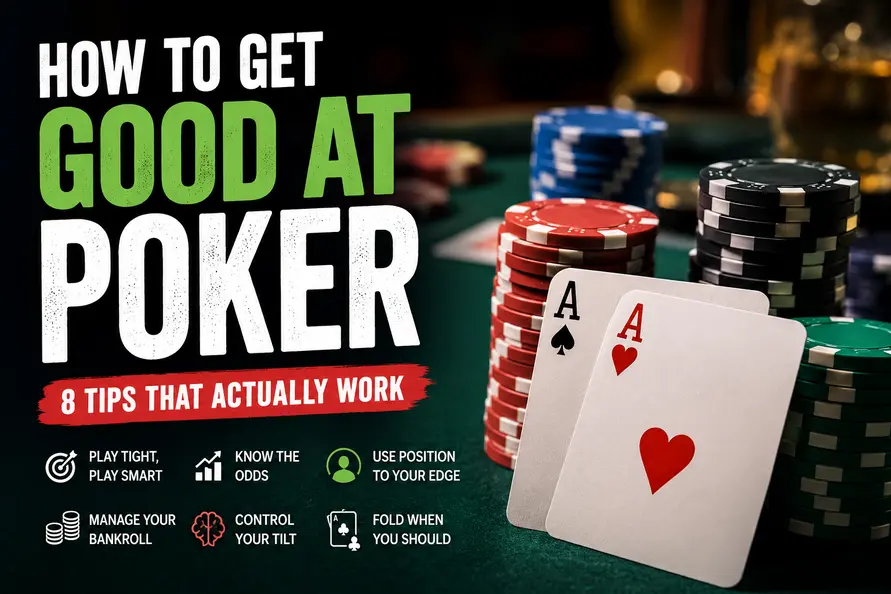
This guide covers the eight things that genuinely moved the needle for me and for most players who actually improve. If you are just starting out, it helps to first get a handle on how to play poker for beginners before diving into strategy. Once you have the basics down, everything below will click a lot faster.
1. Get the Fundamentals Right Before Anything Else
A lot of players want to skip straight to bluffing and reading tells. I get it, that stuff looks cool. But if you do not have hand rankings, position, and basic bet sizing locked in, you are just guessing at every decision. And guessing consistently costs money.
Spend time on the basics early and you will develop faster than players who tried to shortcut past them. Every advanced concept in poker is built on top of the fundamentals. Without that foundation, even good advice does not land the way it should.
2. Learn the Poker Odds and Actually Use Them
This one changed everything for me. Once I started making decisions based on probability rather than gut feeling, my results got more consistent almost immediately. The concept is straightforward: you compare how likely you are to make your hand against how much the pot is offering you to call. Learning how pot odds work is one of the most important skills in poker because it helps you determine whether a call is mathematically profitable. If the math says call, you call. If it does not, you fold.
You do not need to crunch numbers in your head mid-hand. You just need to learn the poker odds well enough to have a feel for whether a situation is profitable. That feel comes from studying the numbers away from the table so they become second nature when you are actually playing.
3. Play Fewer Hands and Play Them with Purpose
One of the first things I noticed when I started playing better poker was that I was folding a lot more pre-flop. That felt wrong at first. Folding feels passive. But the reality is that playing too many hands is one of the most common reasons recreational players lose money consistently.
When you get better at poker, you start to see that folding weak hands is not passive at all. It is protecting your stack so you can be aggressive with the hands that actually have value. The tight-aggressive approach works at almost every stake level because it gives you better hands in more favourable situations. You win more when you play, and you lose less when you do not.
4. Position is Worth More Than Most Players Realise
I used to play hands the same way regardless of where I was sitting. That was a mistake I made for longer than I want to admit. Your position at the table relative to the dealer button is one of the biggest factors in how profitable any given hand can be.
When you act after your opponents, you have information they do not. You see how they bet, whether they check, how much they put in. That context changes everything. A hand that is a fold in early position can be a profitable call or raise from the button. If you want to improve at poker, start paying attention to where you are sitting before you decide how to play a hand.
5. Some Hands Look Decent and Cost You Constantly
There is a specific kind of pain in poker that comes from hands that feel playable but just keep losing. Weak aces out of position. Low pocket pairs facing a raise. Suited connectors in bad spots. These hands are not obviously bad, which is exactly why they trap players into calling when they should be folding.
Part of learning how to play better poker is doing an honest audit of which hands keep putting you in spots you cannot handle. If you keep finding yourself in tough situations post-flop with certain holdings, that is your answer. Our breakdown of the 10 Worst Hands in Poker is a good starting point if you want to see which cards are quietly draining most players’ stacks.
6. The Players Who Improve Fastest Study Off the Table
There was a stretch where I was putting in a lot of hours at the table and barely improving. Then I started spending time reviewing hands after sessions, working through spots I had played badly, and reading about concepts I was shaky on. The improvement that followed in a few weeks was more than I had made in months of just playing.
Playing volume matters but it is not enough on its own. If you play without reflecting on your decisions, you tend to reinforce the same patterns over and over. A simple habit that works well: after each session, pick two or three hands where you felt unsure and think through what a better play would have been. Over time that kind of review compounds into real skill development.
7. Protect Your Bankroll Like It Matters
Being good at poker over the long run is not just about making good decisions at the table. It is about still being in the game when variance turns against you. Every player, no matter how skilled, goes through losing stretches. What separates the ones who survive those stretches from the ones who go broke is bankroll management.
A reasonable guideline for cash games is having at least 20 to 30 buy-ins at whatever stake you are playing. That buffer gives you enough room to ride out a downswing without being forced to drop stakes or stop playing altogether. Treating your bankroll with that kind of discipline is what gives your skill the opportunity to actually show up in your results.
8. Your Emotions Will Cost You More Than Bad Cards
I have lost more money on tilt than I have on genuinely bad decisions. That is probably true for a lot of players who have been honest with themselves about it. After a bad beat or a cooler, the temptation to play looser, call wider, or force something back is real. And it almost always makes things worse.
Knowing how to win at poker in the long run comes down to treating each hand as its own decision, completely separate from what just happened. That takes practice and self-awareness. The most useful thing I learned was to recognize the feeling early, before it affects my play, and just walk away from the table for a bit. That break has saved me more money than any strategy article I have ever read.
Frequently Asked Questions
How long does it take to get good at poker?
Most players start to see real progress within three to six months of consistent play combined with actual study. The basics can click fairly quickly. Getting to a point where your game holds up across different stakes, different player types, and different formats takes longer. The players who improve fastest are usually the ones doing honest reviews of their sessions rather than just grinding volume and hoping for better results.
What is the fastest way to improve at poker?
Combining play with honest review is the fastest route. After sessions, go back to the hands you played badly or felt uncertain about and work through what a better decision would have looked like. Focus on position, starting hand selection, and pot odds before anything else. Once those are solid, everything more advanced becomes much easier to learn and apply.
Should beginners start with cash games or tournaments?
Cash games are the better starting point for most people. The decisions are cleaner, the stakes stay the same throughout, and you can leave whenever you want without penalty. Tournaments add layers like stack depth management and bubble pressure that can be overwhelming before you have a solid base game. Get comfortable in cash games first and the tournament-specific stuff will be much easier to pick up later.
Is poker more skill or luck?
On any given day, luck plays a real role. Anyone can win or lose a session regardless of how well they played. Over a large enough sample, skill takes over as the dominant factor. That is why consistent winners exist and why professionals are able to make long-term profits in a game with built-in randomness. The bigger your sample, the more your results reflect your actual ability rather than short-run variance.
How do I stop losing money at poker?
Start by identifying your actual leaks instead of blaming variance. The most common ones are playing too many hands, calling too much in bad spots, ignoring positional disadvantage, and making emotional decisions after tough beats. Keep a session log, review the hands that hurt the most, and work on one problem at a time. Pair that with sensible bankroll management and your results will start to stabilize as your decisions improve.