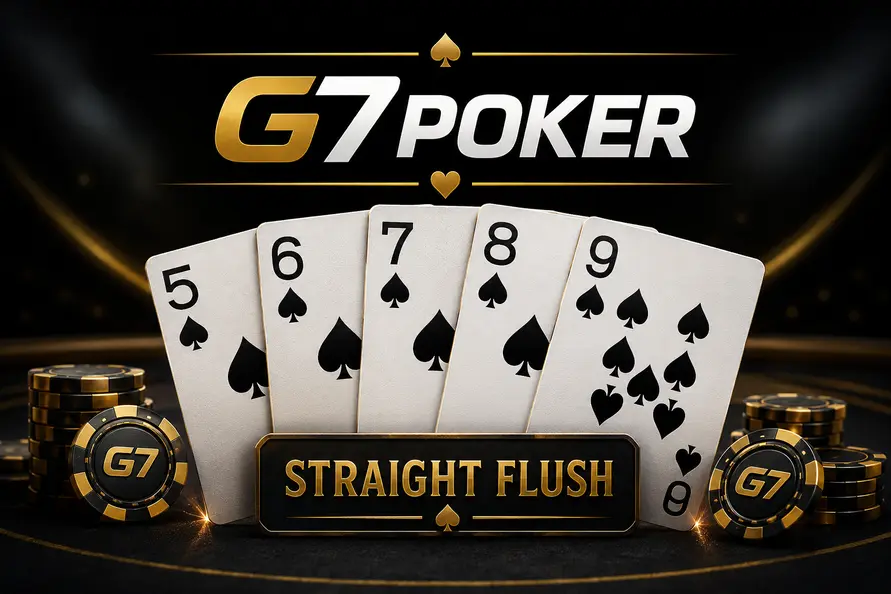
A straight flush is the second-highest hand in poker: five cards of the same suit in unbroken sequence, such as 8-9-10-J-Q of hearts. Only one hand outranks it, the royal flush, simply the highest possible straight flush (10-J-Q-K-A of a single suit). Every other hand loses to it, including four of a kind and a full house. In a random five-card deal, you will see one roughly once every 72,192 hands, one of the rarest hands you can be dealt.
What Is a Straight Flush?
A straight flush is a five-card poker hand in which every card shares the same suit and the ranks run in unbroken order, such as 5-6-7-8-9 of clubs. It combines two hand types that are each hard to make on their own, a straight and a flush, into a single hand that only the royal flush can defeat. Suit carries no weight on its own; a 9-high straight flush in spades is worth exactly the same as a 9-high straight flush in hearts.
Common examples include 2-3-4-5-6 of diamonds (six-high), 7-8-9-10-J of clubs (jack-high), A-2-3-4-5 of spades (five-high, often nicknamed the “steel wheel”), and 10-J-Q-K-A of hearts, the highest straight flush possible, better known as the royal flush.
The ace is flexible, but only in one direction at a time: it can anchor the low end of a five-high straight flush (A-2-3-4-5) or the high end of a royal flush (10-J-Q-K-A), but it cannot wrap around a corner. A hand like K-A-2-3-4 is not a valid straight flush under standard rules, regardless of suit.
Where a Straight Flush Ranks
Here’s how a straight flush stacks up against the complete poker hand rankings, from royal flush down to high card.
| Rank | Hand | Example | Loses Only To |
|---|---|---|---|
| 1 | Royal Flush | 10-J-Q-K-A, one suit | Nothing |
| 2 | Straight Flush | 5-6-7-8-9, one suit | Royal Flush or a higher Straight Flush |
| 3 | Four of a Kind | 7-7-7-7-K | Straight Flush and Royal Flush |
| 4 | Full House | J-J-J-4-4 | Four of a Kind and higher |
| 5 | Flush | Five same-suit cards, not sequential | Full House and higher |
| 6 | Straight | Five sequential cards, mixed suits | Flush and higher |
| 7 | Three of a Kind | 9-9-9-2-5 | Straight and higher |
| 8 | Two Pair | K-K-4-4-9 | Three of a Kind and higher |
| 9 | One Pair | Q-Q-8-5-2 | Two Pair and higher |
| 10 | High Card | A-J-8-4-2, no pair | Every other hand |
Straight Flush vs. Royal Flush: What’s the Difference?
The two get confused constantly, so it helps to see them side by side. A royal flush is not a separate category; it is simply the highest-ranked straight flush that exists.
| Straight Flush | Royal Flush | |
|---|---|---|
| Composition | Any five consecutive same-suit cards | Specifically 10-J-Q-K-A, same suit |
| Rank | Second highest overall | Highest possible, no exceptions |
| Combinations in a 52-card deck | 36 (royal flushes excluded) | 4 |
| Odds, five-card deal | About 72,192 to 1 | About 649,739 to 1 |
What Beats a Straight Flush?
Only a royal flush beats a straight flush, and even that is really just a higher straight flush rather than a different hand. Nothing else in the standard rankings can defeat it: four of a kind, a full house, a flush, a straight, and everything below those all lose automatically.
When two players both hold a straight flush, the pot goes to whoever has the higher top card: a queen-high straight flush beats a jack-high one. If both hands are identical in rank, which happens when the board itself completes the sequence for everyone, the pot splits evenly; suit is never a tiebreaker in standard poker.
Does a straight flush beat four of a kind? Yes, without exception. Four of a kind is the third-strongest hand, and the gap comes down to combinatorics: there are 624 possible four-of-a-kind hands compared with only 36 non-royal straight flushes, so the rarer hand wins.
Does a straight flush beat a full house? Yes. A full house wins most showdowns it enters, but it sits two full tiers below a straight flush; even the best possible full house, aces full of kings, loses to the weakest straight flush, the five-high steel wheel.
Straight Flush Odds: How Rare Is It, and How Do You Calculate It?
In a five-card deal, the probability of a straight flush is roughly 0.00139%, or odds of 72,192 to 1 against. In Texas Hold’em, building the best five cards out of seven shortens those odds to about 1 in 3,589. Here is exactly how those numbers are worked out.
Step 1: Count Every Possible Five-Card Hand
Before calculating any specific hand’s odds, you need the size of the full sample space. A poker hand draws five cards from 52 without regard to order, calling for a combination rather than a permutation. Using C(52,5), that works out to 2,598,960 unique five-card hands, the denominator behind every poker probability you will calculate.
Step 2: Count the Straight Flush Combinations
Within one suit, there are exactly 10 possible five-card sequences, from A-2-3-4-5 at the bottom to 10-J-Q-K-A at the top; multiplied by four suits, that is 40 straight-flush-type hands total. Four of those, one per suit, are royal flushes, which standard rankings treat as their own higher category rather than folding into “straight flush.” Subtract those four, and 36 remain as straight flushes proper, which is why some sources cite 36 and others cite 40.
Step 3: Divide to Get Your Probability
Divide the qualifying hands by the total sample space: 36 divided by 2,598,960 equals approximately 0.00139%, or odds of roughly 72,192 to 1 against. Running the same math with 40 instead of 36 gives the odds of a straight flush “or better” (royal flush included), a slightly better 64,973 to 1. This single division step is where every published straight flush statistic ultimately comes from, whether the source states it as a percentage or as odds.
Step 4: Adjust the Math for Texas Hold’em
The math changes with seven cards in play, since Hold’em lets you pick the best five from two hole cards plus five community cards. The sample space becomes C(52,7), equal to 133,784,560 combinations, and the count containing at least a straight flush rises accordingly. The commonly published result: roughly 0.0279%, or about 1 in 3,589, several times more likely simply because more cards are in view.
| Scenario | Probability | Odds Against |
|---|---|---|
| Straight flush, 5-card deal (royal flush excluded) | 0.00139% | 72,192 to 1 |
| Straight flush “or better,” 5-card deal | 0.00154% | 64,973 to 1 |
| Royal flush only, 5-card deal | 0.000154% | 649,739 to 1 |
| Straight flush, Hold’em by the river (royal flush excluded) | 0.0279% | 3,589 to 1 |
| Royal flush only, Hold’em by the river | 0.0032% | Roughly 30,939 to 1 |
Common Mistakes Players Make With a Straight Flush
1. Assuming Any Suited Hand Is Close to a Straight Flush
Newer players often see two or three suited cards and imagine a straight flush is within reach, when most suited holdings never come close to a five-card run. A straight flush needs five specific consecutive ranks in one suit, not simply “a lot of one suit.” Before getting attached to the idea, count how many outs actually complete the run rather than just keep the dream alive.
2. Overplaying the Hand and Folding Out the Field
Once a player completes a straight flush, the instinct is often to push chips in as fast as possible. Betting too aggressively on a scary board frequently signals danger and folds out every hand except the rare one that beats you. In my experience, players lose more value from overplaying a straight flush early than from sizing bets patiently and letting worse hands catch up.
3. Forgetting a Higher Straight Flush Can Still Be Out There
It is easy to feel invincible holding a straight flush, but it is not automatically the winner. If the board displays four cards of a suited sequence, any opponent holding the missing card of that run has already beaten you, royal flush included. Checking the board before committing an entire stack takes a few seconds.
4. Confusing a “Flush Draw” With a “Straight Flush Draw”
These are different hands with very different odds, and mixing them up leads to real miscalculations. A flush draw needs one more card of a single suit to complete a flush of any ranks, while a straight flush draw needs one specific card, of one specific suit, to complete a sequential run. The second is dramatically rarer, so calling a bet based on ordinary flush-draw odds when the actual draw is a straight flush draw (or the reverse) can be an expensive error.
Straight Flush Across Poker Variants
Not every poker game treats a straight flush identically, and the differences matter beyond standard Texas Hold’em.
Short Deck Hold’em (6+ Hold’em): removing cards below a 6 shrinks the deck to 36, making flushes harder to make relative to full houses. Most rule sets rank a flush above a full house as a result, though the straight flush still sits directly below the royal flush.
Omaha and Pot-Limit Omaha: four hole cards are dealt instead of two, but a straight flush still requires exactly two hole cards and three community cards. The extra hole cards raise your chances of catching one, since more suited combinations are available.
2-7 Triple Draw and other lowball games: the goal is to make the worst possible hand, which flips a straight flush’s value entirely. Here it is a disaster rather than a triumph, since players are actively trying to avoid the combination that wins everywhere else.
Key Takeaways
- A straight flush is five cards of one suit in consecutive order; only a royal flush, itself just the highest possible straight flush, beats it.
- The odds of being dealt one in a random five-card hand are about 72,192 to 1; in Texas Hold’em, that shortens to roughly 1 in 3,589 by the river.
- When two straight flushes meet at showdown, the higher top card wins; identical ranks split the pot, since suit never breaks ties.
- A straight flush always beats four of a kind and a full house, with no exceptions, because far fewer straight flushes exist than either of those hands.
- Rankings can shift by variant (Short Deck ranks a flush above a full house, and lowball games invert the hand’s value entirely), so confirm the specific game’s rules before assuming standard rankings apply.