Free Poker Odds Calculator
Use our free poker odds calculator below to instantly see your win equity, pot odds, and hand probabilities for any Texas Hold’em situation. This poker probability calculator runs 10,000 simulations in real time, so the numbers you see are accurate enough to study with and learn from.
Select your hole cards, add up to 5 opponents, then add the flop, turn, and river as the hand plays out. The poker equity calculator updates automatically with every card you add.
How to Use the Poker Calculator
- Select your hole cards by tapping the + buttons in the ‘You’ player box.
- Add your opponent’s cards if you know them, or leave them blank for a range simulation.
- Add more players using the Add Player button (up to 6 players total).
- Enter community cards in the board section as each street is dealt.
- The poker hand odds and win percentages update in real time after every card selection.
You can also use this as a poker hand probabilities trainer. Run the same scenario multiple times, change one variable, and see how dramatically the odds shift. This is one of the fastest ways to build genuine poker math intuition.
Poker Odds and Probabilities: The Complete Guide
Poker is not purely a game of luck. Every professional player relies on a solid understanding of poker odds and probabilities to make profitable decisions at the table. Whether you are a beginner learning the basics or an experienced player trying to sharpen your math, this guide covers everything you need.
This complete guide walks you through every core concept: how to count your outs, how to calculate pot odds on the fly, when implied odds change your decision, how expected value guides every bet, and how equity determines who is actually winning a hand at any given moment.
Each section links to a dedicated deep-dive article. Use this page as your home base as you build your poker math foundation.
What Are Poker Odds?
Poker odds are a way of expressing probability: the likelihood that a certain event will happen. At the poker table, you constantly face one central question: Is my chance of winning this pot worth the price I’m being asked to pay?
Odds can be expressed in two main formats:
- Ratio Odds (e.g., 3:1): Read as ‘3 to 1 against.’ For every 3 times you lose, you win once. This format is common in live poker conversations.
- Percentage (e.g., 25%): Your chance of winning expressed out of 100. Easier to compare against pot odds percentages.
To convert between them: if your odds against are X:1, your win percentage is 1 / (X+1) x 100. So 3:1 equals 25%.
| KEY PRINCIPLEPoker decisions are profitable when your probability of winning is higher than the pot odds percentage you are being offered. Everything else in this guide flows from that single idea. |
Why Poker Is a Game of Decisions, Not Results
A critical mindset shift for improving players: the outcome of a single hand is not what matters. The quality of your decision is what matters. You can make the mathematically correct call and still lose. Over thousands of hands, correct decisions always generate profit. This is why understanding poker odds and probabilities is the foundation of all serious poker strategy.
A good poker calculator like the one on the web page helps you see this in action. Run the same hand multiple times and you will notice that even an 80% favorite loses 1 in 5 times. That is normal variance, not bad luck.
Poker Outs: How to Count Them
An “out” is any card remaining in the deck that will improve your hand to likely be the best hand. Counting your outs is the essential first step in all poker math. Before you can decide whether a call is profitable, you need to know how many cards can help you.
How to Count Outs: Step by Step
- Identify the hand you currently hold. Look at your hole cards and the community cards on the board.
- Identify what you are drawing to. What hand would make you confident you are winning? A flush? A straight? Two pair?
- Count the unseen cards that complete your draw. How many of those cards are still in the deck?
- Subtract any tainted outs. Some cards that complete your draw might also complete a better hand for your opponent. Those are not clean outs.
That same awareness of what cards remain is the foundation of counting cards in poker, which works differently than most players expect.
| 📌 EXAMPLE: FLUSH DRAW ON THE FLOPYou hold A♥ 9♥ and the flop is K♥ 7♣ 3♥. You have four hearts. There are 13 hearts in the deck total and you can see 4 of them. That leaves 9 remaining hearts, which are your 9 outs to make the flush. You can verify this instantly using the poker probability calculator on the web page. |
Common Drawing Hands and Their Outs
| Drawing Hand | Outs | Example |
| Flush draw | 9 | Four cards of one suit |
| Open-ended straight draw (OESD) | 8 | 5-6-7-8, needs 4 or 9 |
| Two overcards | 6 | AK vs pair on board |
| Gutshot straight draw | 4 | 5-6-8-9, needs 7 |
| One overcard | 3 | A vs pair on board |
| Flush draw + OESD combo | 15 | Monster draw |
The Rule of 2 and 4
Once you know your outs, you can convert them to a win probability quickly using the Rule of 2 and 4:
- On the flop (2 cards to come): Outs x 4 = approximate equity %
- On the turn (1 card to come): Outs x 2 = approximate equity %
| FLOP: Outs x 4 = approx. equity % | TURN: Outs x 2 = approx. equity % |
| 📌 EXAMPLE Flush draw (9 outs) on the flop: 9 x 4 = roughly 36% chance of hitting by the river.After the turn misses: 9 x 2 = roughly 18% chance on the river.The poker equity calculator shows the exact number, but the Rule of 2 and 4 is accurate enough for live play. |
Pot Odds in Poker: How to Calculate
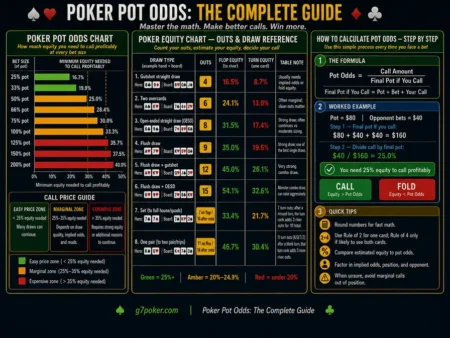
Pot odds are the ratio between the current size of the pot and the cost of a call. They tell you the minimum winning percentage you need for a call to be mathematically break-even. If your actual win probability (equity) is higher than the pot odds percentage, calling is profitable.
| Pot Odds % = Call Amount / (Pot + Call Amount) x 100 |
| 📌 EXAMPLE: POT ODDS CALCULATION Pot is $100. Opponent bets $50. You must call $50.Total pot if you call: $100 + $50 + $50 = $200Pot Odds: $50 / $200 = 25%You need to win at least 25% of the time.Flush draw at roughly 36% equity = profitable call. Gutshot at roughly 16% = fold. |
Pot odds and the poker hand odds shown in the calculator work together. The calculator gives you your equity. You calculate your pot odds manually from the bet sizes. Then you compare the two numbers to make your decision.
Quick Pot Odds Reference by Bet Size
| Opponent’s Bet (vs Pot) | Pot Odds % | Verdict |
| 1/4 pot (25%) | ~17% | Wide call range |
| 1/2 pot (50%) | ~25% | Standard range |
| 3/4 pot (75%) | ~30% | Narrower range |
| Full pot (100%) | ~33% | Strong draws only |
| 2x pot (200%) | ~40% | Near-favorite needed |
Implied Odds vs Pot Odds
Pot odds only consider the money currently in the pot. Implied odds account for the money you expect to win in future streets if you hit your draw. A call that looks unprofitable based on pure pot odds can become very profitable when implied odds are factored in correctly.
| Pot Odds | Implied Odds | |
| What it measures | Money in pot vs call cost | Expected future winnings too |
| Best used on | The river (no cards left) | Flop and turn decisions |
| Certainty | Precise and calculable | Estimated, opponent-dependent |
When to Use Implied Odds
Implied odds are strongest when your draw is hidden (your opponent cannot easily see what you are chasing), the effective stack sizes are deep (more money to win on future streets), and your opponent is the type of player who pays off big hands.
When Implied Odds Are Poor
- Your draw is obvious to your opponent (for example, four cards to a flush visible on the board)
- Effective stacks are short and there is little money left to win
- Your opponent is tight and will often fold when the scary card hits
- You could be drawing to the second-best hand (for example, the low end of a straight)
Reverse Implied Odds
Reverse implied odds are the money you might lose on future streets when you make your hand but it is still not good enough. For example, making a low flush when your opponent has a higher flush, or hitting two pair when they already have a set. Always consider both sides before calling with a drawing hand.
Expected Value (EV) in Poker
Expected Value (EV) is the single most important concept in poker mathematics. It is the average amount you expect to win or lose from a decision if that exact situation were repeated thousands of times. Every bet, call, raise, and fold has an EV. The goal is to make as many +EV decisions as possible.
| CORE EV PRINCIPLE A decision is +EV (positive expected value) if it makes money over the long run. It is -EV (negative expected value) if it loses money. One bad outcome does not mean a decision was wrong. Only the math determines that. |
| EV = (Win% x Amount Won) – (Lose% x Amount Lost) |
| 📌 EXAMPLE: EV CALCULATION Pot is $200. Opponent bets $100. You estimate a 40% chance of having the best hand.Win (40%): you win $300Lose (60%): you lose $100EV = (0.40 x $300) – (0.60 x $100) = $120 – $60 = +$60This call is +EV. Even though you will lose it 60% of the time, it is the correct long-run decision.The poker odds calculator on the web page shows you your win percentage for any spot. Pair that with the EV formula above for a complete decision-making system. |
EV of Bluffing: Breakeven Fold Percentage by Bet Size
| Bluff Size (vs Pot) | Opponent Must Fold… |
| 1/4 pot | 20% of the time |
| 1/2 pot | 33% of the time |
| 3/4 pot | 43% of the time |
| Full pot | 50% of the time |
| 2x pot | 67% of the time |
6. Equity in Poker Explained
Poker equity is your share of the pot based on your current probability of winning the hand.If you have 60% equity in a $100 pot, your mathematical share of that pot is $60.The poker equity calculator on the web page shows you this number for any hand combination.
Equity is the bridge between outs, odds, and actual decision-making. Once you know your equity, you can compare it directly to the pot odds you are being offered to decide if a call is profitable.
Hand vs Hand Equity vs Hand vs Range Equity
- Hand vs Hand Equity: Your exact two cards against your opponent’s exact two cards. 100% precise.Useful for studying specific matchups.
- Hand vs Range Equity: Your exact hand against a distribution of possible hands your opponent could hold.More realistic and more useful at the table.
Common Poker Hand Probabilities and Equity Matchups
These are the most important poker hand probabilities every player should memorize:
| Matchup | Example | Equity Split |
| Overpair vs Underpair | AA vs KK | ~80% / 20% |
| Pair vs Two Overcards (Coinflip) | 77 vs AK | ~53% / 47% |
| Top pair vs Flush Draw | KQ vs A♥9♥ on K♥7♥3♠ | ~60% / 40% |
| Dominated hand | AK vs AQ | ~73% / 27% |
| Set vs Straight Draw | 333 vs 8♣9♦ on 5♣6♦7♥ board | ~65% / 35% |
Use the poker calculator on the web page to explore more matchups. Enter any two hands, leave the board blank, and you will see the exact preflop equity split instantly.
Equity vs EV: Key Difference
| Equity | EV | |
| What it tells you | Your % share of the pot right now | Whether a decision is profitable |
| Accounts for bet sizing? | No | Yes |
| Future streets? | Assumes no more betting | Fully accounts for future action |
| Use case | Understand who is winning a hand | Decide whether to bet / call / fold |
Poker Hand Odds and Probabilities
Understanding the base poker hand odds of being dealt certain hands is just as important as calculating odds during a hand. Here are the fundamental poker hand probabilities for Texas Hold’em preflop:
| Hand Type | Combinations | Probability | Odds Against |
| Any pocket pair | 78 | 5.88% | 16:1 |
| Pocket aces (AA) | 6 | 0.45% | 220:1 |
| Any two suited cards | 312 | 23.5% | 3.25:1 |
| Suited connectors (e.g., 8♠9♠) | 48 | 3.6% | 26.7:1 |
| AK (suited or offsuit) | 16 | 1.2% | 81.9:1 |
| AK suited | 4 | 0.3% | 331:1 |
| Premium hand (TT+, AK) | 46 | 3.47% | 27.8:1 |
Poker Hand Probabilities After the Flop
| Made Hand on the Flop | Probability |
| Flopping a set (with a pocket pair) | 11.8% |
| Flopping two pair (with unpaired hole cards) | 2.0% |
| Flopping a flush draw (with suited hole cards) | 10.9% |
| Flopping an open-ended straight draw | 9.0% |
| Flopping top pair | ~32% |
To check any of these scenarios yourself, use the poker probability calculator on the web page. Enter your preflop hand, leave the board blank, and run multiple simulations to see how often each outcome occurs.
Putting It All Together
These five concepts form a decision-making chain that runs through every hand you play. Here is how they connect in a real hand:
- Count your outs. “I have 9 outs to a flush.”
- Calculate your equity. “9 outs x 4 = roughly 36% equity on the flop.” (Or check the poker equity calculator on the web page.)
- Calculate pot odds. “I need to call $50 into a $150 pot = 25% pot odds.”
- Factor in implied odds. “Opponent has $300 behind and tends to pay off big hands. Good implied odds.”
- Calculate the EV. “36% equity is greater than 25% pot odds, plus solid implied odds. This is a clear +EV call.”
| THE BOTTOM LINE You will not do all this math explicitly in every single hand. But internalizing these concepts trains your intuition.Over time, recognizing +EV spots becomes automatic. That is what separates consistent winners from recreational players.The best way to practice is to set up scenarios in the poker odds calculator, make your decision first based on the math, then run the simulation to see if your read was correct. |
Quick Reference Tables
Outs to Equity Conversion (Rule of 2 and 4)
| Outs | Flop Equity (x4) | Turn Equity (x2) | Draw Type |
| 2 | ~8% | ~4% | Pair to two pair |
| 4 | ~16% | ~8% | Gutshot straight draw |
| 6 | ~24% | ~12% | Two overcards |
| 8 | ~32% | ~16% | Open-ended straight draw |
| 9 | ~36% | ~18% | Flush draw |
| 12 | ~48% | ~24% | Flush + gutshot combo |
| 15 | ~60% | ~30% | Flush + OESD (monster draw) |
Pot Odds Quick Reference
| Pot Odds Ratio | Required Win % | Min Outs Needed (flop) |
| 5:1 | ~17% | 5 |
| 4:1 | ~20% | 5 |
| 3:1 | ~25% | 7 |
| 2:1 | ~33% | 9 |
| 1.5:1 | ~40% | 10 |
| 1:1 | ~50% | 13 |
Poker Odds Calculator FAQs
What is a poker odds calculator?
It is a tool that shows you your chances of winning a hand before all the cards are out. You put in your cards, your opponent’s cards, and whatever is on the board, and it tells you your win percentage instantly. Think of it as having a poker coach do the math for you in seconds.
How do you calculate pot odds in poker?
Take the amount you need to call and divide it by the total pot after your call. So if there is $100 in the pot and your opponent bets $50, you are calling $50 into a $200 pot. That is 25%. If your chances of winning are higher than 25%, calling is the right move.
What is the Rule of 2 and 4?
It is a shortcut pros use at the table when they cannot pull out a calculator. Count your outs, multiply by 4 on the flop or by 2 on the turn, and you get a pretty accurate win percentage. A flush draw has 9 outs, so on the flop you have roughly 36% chance of hitting. Simple and fast.
What is EV in poker?
EV means Expected Value. It basically answers the question: if I made this same decision a thousand times, would I make money or lose money? Good players do not think about one hand at a time, they think about whether a decision is profitable over the long run. That is all EV is.
Is this poker calculator really free?
Yes, completely free. No account, no sign up, nothing. Just open the page, enter your cards and start calculating. Works on mobile too.