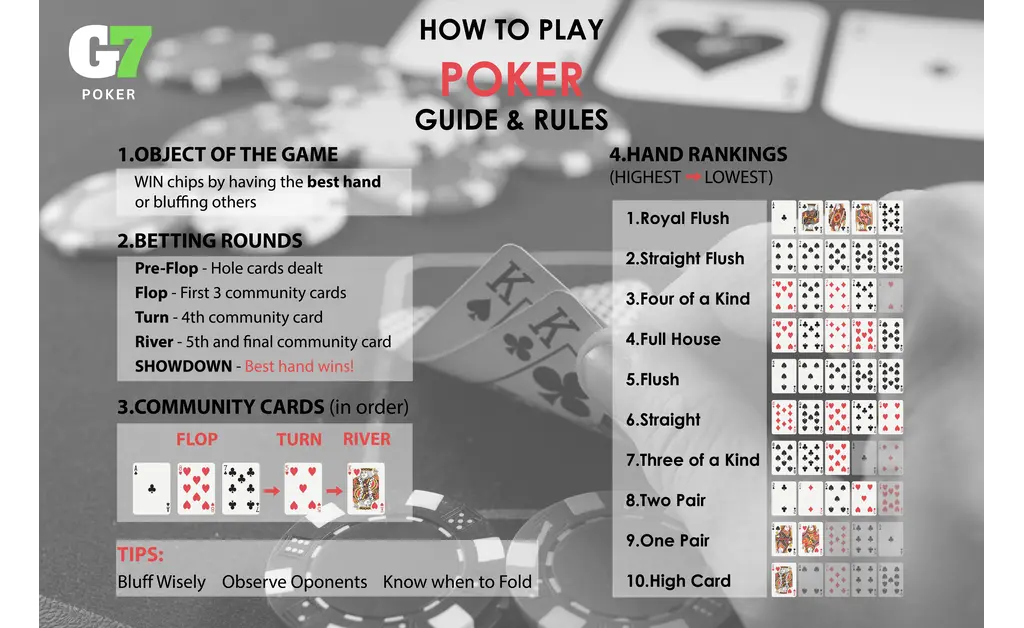
Poker is a card game where players compete to win a pot of chips by either holding the best five-card hand or convincing everyone else to fold. The most popular version is Texas Hold’em, and learning how to play poker is easier than most people think.
This guide covers the basic poker rules, the exact order the game is played, hand rankings, table positions, strategy, and the mistakes that cost most beginners their chips early on. For the official rulebook, see our poker rules guide.
What Is Poker?
Poker is a game where skill, psychology, and luck all compete for the same pot.
You win either by showing the best hand at the end, or by making everyone else believe you have it before it gets that far. That combination of cards and psychology is what keeps players coming back for decades.
The goal every hand is simple: win the pot. You do that through strong cards, smart betting, or well-timed bluffing. Usually it’s a mix of all three.
Basic Poker Terms
Before sitting down at a table, you need to know the language. These are the terms that come up every single hand.
Dealer
The person who distributes the cards. In casinos a professional handles this. In home games the role rotates clockwise after each hand.
Pot
The pile of chips in the middle that everyone is competing to win. The winner of the hand takes everything in it.
Bet
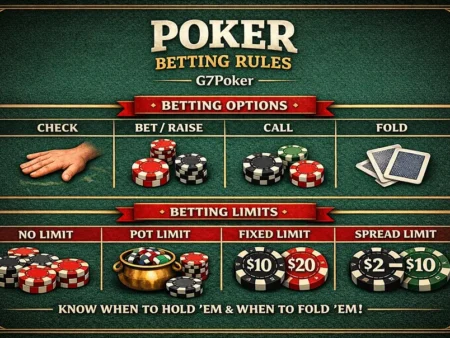
Placing chips into the pot when nobody else has acted yet in that round.
Call
Matching the previous player’s bet to stay in the hand.
Raise
Increasing the size of the current bet, forcing everyone else to respond.
Fold
Giving up your hand and exiting the round. Any chips you’ve already put in stay in the pot.
Check
Passing the action without betting. Only possible if nobody has bet yet in that round.
All-In
Committing every chip you have to the pot. If others keep betting, a side pot is created.
Ante
A small forced contribution every player makes before the hand begins. Common in tournaments to encourage more action.
How to Play Poker – Order of the Game
Every hand of Texas Hold’em follows the same seven steps. Once you’ve been through it a few times, it becomes completely automatic.
Step 1 – Blinds
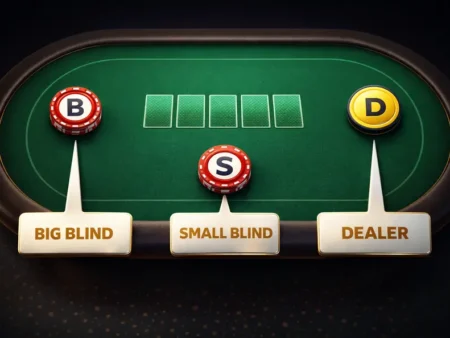
Two players post forced bets before any cards are dealt. The player left of the dealer posts the small blind, the next posts the big blind. These forced bets, known as texas hold’em blinds, seed the pot and give everyone something to play for.
Every player receives two private cards face-down. Only you can see them. These are the foundation of your hand.
Step 3 – Pre-Flop Betting
Based on your two cards, you decide to fold, call the big blind, or raise. Many hands end right here.
Step 4 – The Flop
Three community cards are placed face-up on the table. Everyone can use them. Another round of betting follows.
Step 5 – The Turn
A fourth community card is revealed. The betting gets more serious here with only one card left to come.
Step 6 – The River
The fifth and final community card is dealt. Last chance to bet, bluff, or get out of a bad hand.
Step 7 – Showdown
Any remaining players reveal their cards. The best five-card hand wins the pot.
Poker Hand Rankings
Memorizing hand rankings is the first thing you should do before playing a single hand. Every decision at the table comes back to knowing how strong your hand is.
Here are all 10 hands ranked from strongest to weakest:
- Royal Flush – A, K, Q, J, 10 of the same suit. The best hand in poker.
- Straight Flush – Five consecutive cards of the same suit.
- Four of a Kind – Four cards of the same rank.
- Full House – Three of a kind plus a pair.
- Flush – Five cards of the same suit.
- Straight – Five consecutive cards of mixed suits.
- Three of a Kind – Three cards of the same rank.
- Two Pair – Two separate pairs.
- One Pair – Two cards of the same rank.
- High Card – No combination, your best single card plays.
In practice, pairs, two pairs, and the occasional straight or flush decide most pots. Royal flushes make great stories but they’re rare.
For a full breakdown with examples, check out our complete guide to Poker Hand Rankings.
Basic Poker Strategies
Poker strategy comes down to one thing: making better decisions than your opponents, consistently.
Luck evens out over time. What separates winning players from losing ones is discipline, patience, and the ability to read situations accurately.
Play Selective Hands
Fold more than feels comfortable. Strong starting hands like AA, KK, QQ, and AK give you a real edge before the flop. Weak hands played out of boredom bleed chips quietly over time.
Position Matters
Acting later in a betting round means you’ve already seen what everyone else decided. That information is genuinely valuable. A hand that’s marginal from early position can be very profitable from late position for exactly this reason.
Bluff With Purpose
The best bluffs make sense given the board and how you’ve played the hand. Random aggression gets called and punished. Bluff when the story you’re telling is believable.
Read Your Opponents
Watch how people bet, how fast they act, and how their behavior shifts when they’re confident versus uncertain. These patterns are readable and learning to spot them is what separates decent players from genuinely good ones.
Manage Your Bankroll
Set a budget before you sit down and stick to it. Playing with money you can’t afford to lose leads to scared, passive decisions. Never chase losses by moving up in stakes.
Poker Positions and Their Importance
Position is the most underappreciated concept in poker. Where you sit relative to the dealer changes how you should play almost every hand.
For a full breakdown check out our dedicated guide on poker positions. Here’s the quick version:
Early Position
You act first with the least information. Play tight here and stick to your strongest hands.
Middle Position
Slightly more flexibility than early position, but you’re still not last to act.
Late Position
You act after most players have already shown their intentions. More information means better decisions and a wider range of playable hands.
Dealer / Button
The best seat at the table. You act last in every post-flop round, which is a consistent structural advantage that winning players exploit heavily.
Blinds
You’ve committed chips before seeing your cards and act first after the flop. It’s a built-in disadvantage. The goal from the blinds isn’t to win big, it’s to lose as little as possible.
Where Beginners Make the Most Mistakes
Most money lost by beginners doesn’t come from bad luck. It comes from the same handful of mistakes repeated hand after hand.
Playing Too Many Hands
Every weak hand played out of boredom or optimism is a small leak that adds up fast. Be selective and wait for spots worth playing.
Ignoring Position
The same two cards can be a clear fold from early position and a profitable raise from the button. Position changes the value of your hand. Ignoring it is expensive.
Calling Too Often
Passive poker is losing poker. Every time someone bets, ask yourself whether raising or folding is actually the better move. Defaulting to call is avoiding the decision, not making it.
Playing on Tilt
A bad beat can trigger emotional play that turns a small loss into a large one. The best players reset quickly after tough hands and stick to their process regardless of results.
Lack of Patience
Poker rewards waiting. Players who fold 70% of their hands without complaint, then extract maximum value when they finally have a strong spot, consistently outperform players who force the action.
Tips for Beginners
The gap between a complete beginner and a competent player is smaller than most people think, but it requires intentional practice.
Get the hand rankings automatic before anything else. You shouldn’t be thinking about whether a flush beats a straight at the table.
Play low stakes while learning. The goal at this stage is good decisions, not profit.
Study strategy, not just rules. Understanding why certain plays work in certain spots builds real skill faster than volume alone.
Watch experienced players think through decisions. Whether it’s a home game regular or a professional on a stream, the reasoning process is what’s worth observing.
Use free online games to see as many hands and situations as possible before playing for real money.
Popular Poker Variations
Texas Hold’em is the best starting point, but it’s just one version of a much larger game.
Texas Hold’em
The most widely played poker game in the world. Two hole cards, five community cards, four betting rounds. Simple to learn and endlessly deep to master.
Omaha Poker
Each player gets four hole cards and must use exactly two of them with three community cards. Bigger starting hands create bigger combinations and more action. Pot Limit Omaha has a particularly devoted following.
Seven Card Stud
No community cards. Players receive seven cards over multiple rounds and build the best five-card hand from them. Memory and observation matter more here than in Hold’em.
Five Card Draw
The classic version. Five cards, the option to exchange some, then a final bet. Simple and great for casual play.
Stud Poker
A family of games with face-up and face-down cards dealt across multiple rounds and no shared community cards.
Pai Gow Poker
Players split seven cards into two hands and compete against the dealer. Slower and lower variance than most poker formats.
Caribbean Stud Poker
A casino format where you play against the house rather than other players.
Short Deck Poker (6+ Hold’em)
Hold’em with a 36-card deck. Removing low cards changes hand frequencies and flips some traditional rankings.
Chinese Poker
Each player gets 13 cards and arranges them into three separate hands. A very different format that rewards a specific kind of strategic thinking.
Razz Poker
A stud variant where the lowest hand wins. Everything you know about hand strength gets flipped.
FAQs
Is Poker a Game of Luck or Skill?
Both, but the balance shifts over time. In a single session luck plays a big role. Over thousands of hands, skill takes over. Better decisions compound into consistent results, which is why the same players keep showing up at final tables.
How Many Cards Does Each Player Get in Texas Hold’em?
Two private hole cards to start. Five community cards are then placed on the table over the course of the hand. Your final hand is the best five-card combination from any mix of those seven cards.
What Is the Strongest Hand in Poker?
The Royal Flush: ace, king, queen, jack, and ten of the same suit. It cannot be beaten, only tied. Most players go long stretches without ever seeing one.
What Do Fold, Call, and Raise Mean?
Folding means surrendering your hand and exiting the round. Calling means matching the current bet to stay in. Raising means increasing the bet and forcing everyone else to respond.
How Many Cards Make Up the Final Hand?
Always five. You choose the best five-card combination from your two hole cards and the five community cards on the table.
What Is the Pot in Poker?
The total of all chips bet during the hand. It grows with every bet and raise across all four rounds. The winner takes everything in it at the end.