Blinds in poker are forced bets that two players at the table must post before any cards are dealt. The word “blind” means you’re betting blind without having seen your cards yet.
Without blinds, players could just sit and wait forever for a perfect hand without risking anything. The blinds force money into the pot before cards are dealt, so there’s always something worth playing for from the very first action.
Poker blinds are at the core of almost every poker game you’ll encounter, especially Texas Hold’em. If you’re new to the game and want to understand the full picture first, check out our instructions on how to play poker before going deeper into blinds.
The Two Types of Poker Blinds: Small Blind and Big Blind
The Small Blind
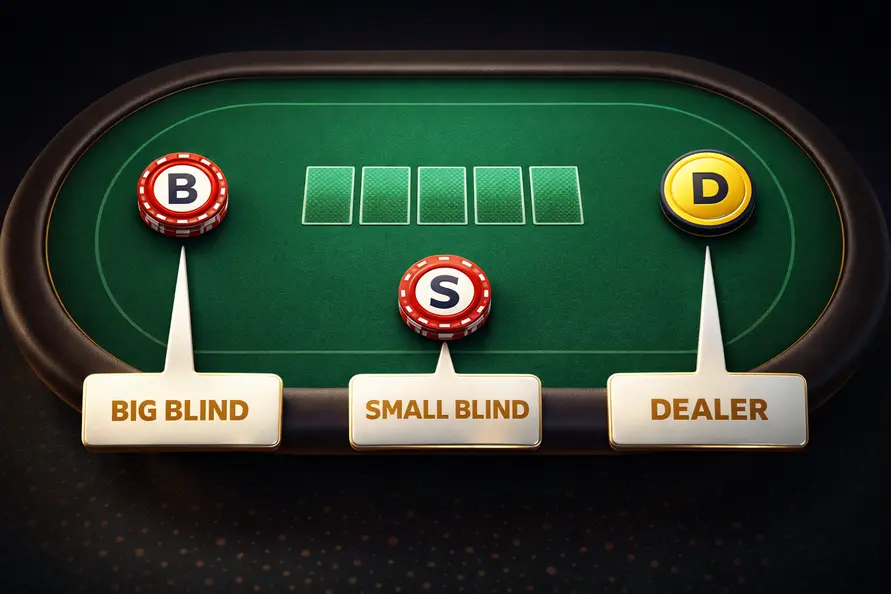
The small blind is posted by the player sitting immediately to the left of the dealer button. It is commonly around half the big blind, though some structures like $1/3 or $2/5 differ slightly. For example, in a $1/$2 game, the small blind posts $1.
The small blind player acts near the end of the pre-flop betting order, just before the big blind (before community cards are dealt) but is first to act on every subsequent street (flop, turn, river). This is considered a positional disadvantage because you’re forced to make decisions before seeing how your opponents act.
The Big Blind
The big blind is posted by the player sitting two seats to the left of the dealer button directly to the left of the small blind. It equals the full minimum bet for that game. In a $1/$2 game, the big blind posts $2.
The big blind is the more expensive of the two forced bets. However, the big blind player has one key advantage pre-flop: if no one raises, they can check and see the flop for free. This is sometimes called the “big blind option.”
How Do Blinds Work in Poker? Step by Step
Here’s exactly how poker blinds work in a live hand of Texas Hold’em:
- The dealer button is assigned to one player this rotates clockwise after every hand.
- The small blind (player to the left of the button) posts their forced bet.
- The big blind (player to the left of the small blind) posts their forced bet.
- Cards are dealt to all players.
- Pre-flop action begins with the player to the left of the big blind (called “under the gun”). Players can call, raise, or fold.
- Action continues clockwise until it reaches the big blind. If no one has raised, the big blind may check or raise. This is known as “closing the action.”
- Once pre-flop betting is complete, the hand continues with the flop, turn, and river and the small blind acts first on each of these streets.
Related Forced Bets – Antes and Straddles
Ante
Antes are additional forced bets posted by all players before each hand, common in tournament play. Unlike blinds, antes are not part of your call amount — but they do contribute to the pot, making it larger before any betting begins.
Straddles
A straddle is an optional blind bet made before the cards are dealt, usually twice the size of the big blind. It gives the straddling player the last option to act pre-flop, effectively moving the action. It raises the stakes at the table and tends to create more aggressive play in the betting rounds that follow. Straddles only apply in cash games and cannot be used in tournaments.
Texas Hold’em Blinds
In Texas Hold’em blinds, the structure varies depending on whether you’re playing a cash game or a tournament.
Cash Game Blinds
In cash games, blinds are fixed for the entire session. Common structures include:
- $0.25/$0.50 (micro stakes, common online)
- $1/$2 (low stakes, standard in live card rooms)
- $2/$5 (mid stakes)
- $5/$10 and above (high stakes)
The blinds define the stakes of the game and determine the buy-in range. Most casinos set the minimum buy-in at 40BB and the maximum at 100BB or more. In a $1/$2 game, for example, you might buy in anywhere from $40 (short stack) to $300 or $500 (deep stack), depending on the house rules. Some tables allow 200BB+ for deep stack play.
Tournament Blinds
In poker tournaments, the blinds increase at set intervals called “levels.” This is by design as the blinds grow, players with short stacks are forced to act, preventing the tournament from going on indefinitely.
For example, a tournament might start with blinds of 25/50, then increase to 50/100, 100/200, and so on, every 15–20 minutes. Many tournaments also add antes at later stages to increase pressure. A popular modern format is the big blind ante, where only the big blind player posts a single ante on behalf of the whole table, used widely in the WSOP and WPT.
Why Blinds Matter for Your Strategy
Playing from the blinds is inherently harder. You’re out of position on every street after pre-flop. Studies of poker data consistently show that the blinds are the two most losing positions at the table over the long run.
Blind defense is a key skill in modern poker. When you’re in the big blind and facing a raise, you’re getting a discount to call because you’ve already invested money in the pot. Knowing when to defend and when to fold comes down to understanding pot odds and position, both of which are covered in depth in the poker betting rules for beginners guide.
Blind stealing is equally important. When you’re on the button or in late position with a weak field between you and the blinds, raising to take the blinds uncontested (a “steal”) is a profitable, high-frequency play in both cash games and tournaments.
Poker Blind Terms Explained
| Term | Meaning |
|---|---|
| Posting the blind | Putting the required forced bet into the pot |
| Defending the blind | Calling or re-raising when someone raises into your blind |
| Blind steal | Raising from late position to win the blinds uncontested |
| Straddle | An optional third blind, typically 2x the big blind, posted by the player to the left of the BB |
| Dead blind | A blind posted by a player returning to the game out of position |
| Ante | An additional forced bet all players post, common in tournaments |
FAQs About Poker Blinds
Do both players in the blinds have to pay every hand?
Yes but the blind positions rotate clockwise after every hand, so every player at the table pays the blinds at regular intervals. In a 9-player game, you post the big blind roughly once every 9 hands.
Can you win the blinds without a showdown?
Absolutely. If everyone folds before reaching showdown, the last remaining player wins the entire pot including the blinds regardless of their cards.
What happens if a player can’t afford the full blind?
In tournaments, if a player’s stack is smaller than the required blind, they post what they have (called going “all-in blind”) and can only win a portion of the pot equal to their contribution.
Are poker blinds the same as antes?
No. Blinds are paid only by two specific players. Antes are paid by every player at the table before each hand. They serve a similar purpose building a pot to incentivize action but function differently.
What is a “live blind”?
A live blind is one where the player who posted it retains the right to raise, even if no one else has raised before the action returns to them. In standard games, the big blind is always a live blind. Note that live blind rules for other situations vary by casino or house rules, so always check the specific format you’re playing.