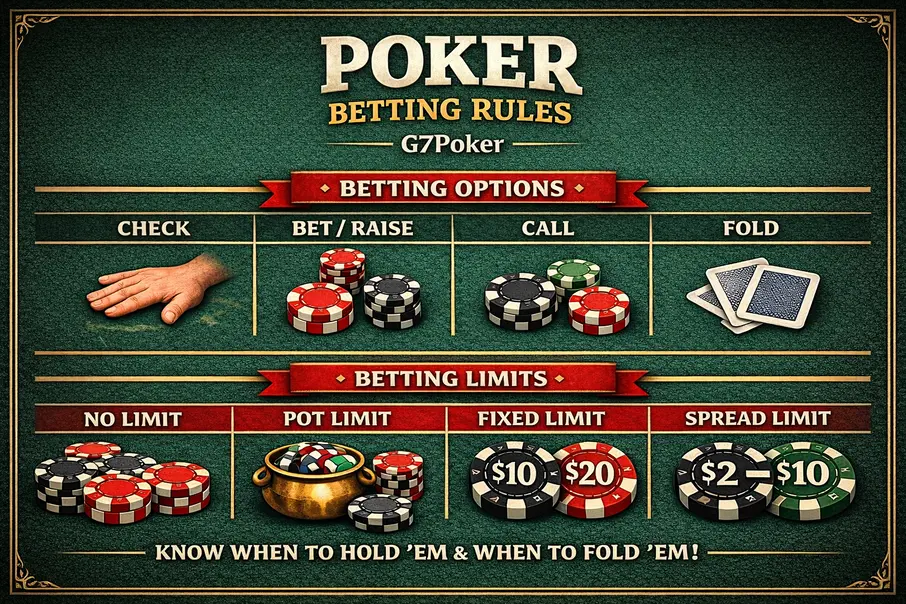
Betting is the engine of poker. Every decision you make at the table is either a bet, a response to one, or a choice to get out of the way.
This guide covers the betting rules in poker that every player needs: the five actions, betting order, forced bets, and how the three main betting structures work. For the official rulebook on violations and table conduct, see our full rules of poker guide.
The Five Betting Actions in Poker
Every time the action reaches you, you have up to five options depending on what the players before you have done.
Check
Pass the action without putting chips in. Only available if no one has bet before you in that round. Checking is not weakness. It is often used to control pot size or trap opponents into betting.
Bet
The first voluntary chips placed into the pot in a given round. Once you bet, every other player must call, raise, or fold. In No-Limit games the minimum bet is the size of the big blind.
Call
Match the current bet to stay in the hand. Calling is the most passive option. Beginners tend to call too often. Every time you face a bet, ask whether raising or folding gives you a better result.
Raise
Increase the size of the current bet, forcing all active players to respond. The minimum raise must be at least equal to the previous bet or raise in that same round. If the big blind is $10 and someone raises to $30, the minimum re-raise is $20 more, making the total at least $50.
Fold
Surrender your hand and exit the round. Chips already in the pot stay there. The fold is final. Folding a bad hand before losing more chips is one of the most profitable decisions in poker over time.
Poker Betting Order: Who Acts First?
Acting later than your opponents gives you more information before you decide. That is a real structural advantage in every hand.
Pre-Flop
The player to the left of the big blind, known as Under the Gun (UTG), acts first. Action moves clockwise. The big blind acts last and has the option to check or raise if no one has raised before them.
Post-Flop (Flop, Turn, River)
From the flop onward, the first active player to the left of the dealer button acts first. The dealer button acts last every post-flop round, which is why it is the best seat at the table. This order stays the same for all three post-flop streets.
| Position | Betting Order |
|---|---|
| Under the Gun (UTG) | First pre-flop. Least information. Play tight. |
| Middle Position | Acts after UTG. Slightly more flexibility. |
| Button (BTN) | Last post-flop every round. Best position at the table. |
| Small Blind (SB) | First post-flop. Most disadvantaged position. |
| Big Blind (BB) | Last pre-flop. Acts early post-flop. |
Forced Bets: Blinds and Antes
Forced bets ensure there is always something worth competing for. Without them, players could wait indefinitely for premium cards at zero cost.
Blinds
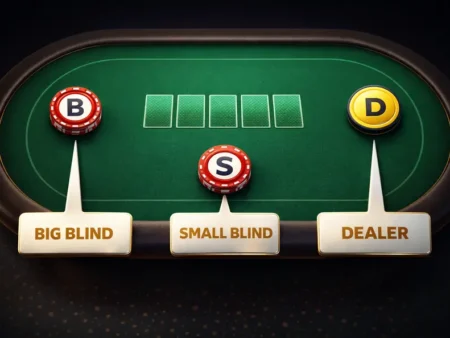
The small blind and big blind are posted by the two players to the left of the dealer button before any cards are dealt. In a $1/$2 No-Limit game, the small blind is $1 and the big blind is $2. Every other player must at least call $2 to enter the hand. The blinds rotate one seat clockwise every hand so all players pay them equally over time.
Antes
An ante is a forced bet posted by every player before the hand begins. Common in tournament poker, antes create a larger starting pot and encourage more action. Many modern tournaments use a “big blind ante” where only the big blind posts the ante on behalf of the whole table to speed up gameplay.
Poker Betting Structures: No-Limit, Pot-Limit, and Fixed-Limit
The betting structure defines how much you are allowed to bet or raise. Always confirm the structure before sitting down.
No-Limit
You can bet any amount from the minimum bet up to all your chips at any time. This is the structure used in most Texas Hold’em games. The minimum bet equals the big blind. The maximum is your entire stack.
Pot-Limit
The maximum bet or raise is the current size of the pot. Most common in Pot-Limit Omaha. To calculate the maximum raise: call the current bet first, then raise by the new pot total. If the pot is $100 and someone bets $100, you call $100 (pot becomes $300) and can raise up to $300, making your total action $400.
Fixed-Limit
All bets and raises are a fixed size. Pre-flop and on the flop, bets use the small bet. On the turn and river, bets double to the big bet. In a $2/$4 Fixed-Limit game, all pre-flop and flop bets are $2, all turn and river bets are $4. Raises are typically capped at four per round.
Raise Rules: Re-Raises and 3-Bets
A re-raise, commonly called a 3-bet, is a raise against another player’s raise. The name comes from counting actions: the big blind is bet one, the raise is bet two, the re-raise is bet three. A 4-bet is a raise against a 3-bet, and so on.
In No-Limit and Pot-Limit games there is no cap on the number of re-raises. In Fixed-Limit games, raises are capped at four per round. Once that cap is reached, players can only call or fold.
Poker Betting Rules for Beginners: Mistakes to Avoid
- Betting out of turn. Always wait for the action to reach you. Acting early gives other players information they should not have.
- Announcing a raise then changing it. Verbal declarations are binding. Once you say raise, you must raise.
- Not putting in enough to raise. Always announce your action clearly. Placing chips without a verbal declaration can be interpreted as a call.
- Ignoring the betting structure. Going all-in in a Pot-Limit game when the pot does not cover it is a rules violation. Know the structure before you play.
- Calling too often. Passive poker loses money. Every time someone bets, ask whether raising or folding is the better option.
Poker Betting Rules FAQ
What Is the Poker Betting Order?
Pre-flop, the player left of the big blind acts first. Post-flop, the first active player left of the dealer button acts first. Action always moves clockwise.
What Is the Minimum Raise in Poker?
The minimum raise must be at least equal to the previous bet or raise in the same round. You cannot raise by less than the amount of the last raise.
Can You Check After Someone Bets?
No. Once a bet has been made in a round, you must call, raise, or fold. Checking is only available when no one has bet yet.
Is Check-Raising Allowed?
Yes, in virtually all professional and casino games. You check, let someone else bet, then raise when the action comes back to you. Some home games ban it by house rule.
What Happens If You Do Not Have Enough Chips to Call?
You can go all-in for whatever you have left. You remain eligible to win the main pot up to the amount you contributed. Any additional betting between other players forms a side pot you cannot win.
What Is the Difference Between a Bet and a Raise?
A bet is the first chips placed in the pot when no one has acted yet that round. A raise increases a bet that already exists. You can only raise another player’s bet, not your own.